Level 1
Augmented
AI as an assistant. It makes suggestions, summarises literature and speeds up analysis. The researcher decides; AI supports.

How we think about the role of artificial intelligence in research and in the Hungarian Research Network (HUN-REN).
of researchers already use AI tools in their work
believe AI will help accelerate knowledge discovery
say AI improves the quality of their work and frees up time
AI is increasingly becoming core infrastructure for scientific work. It no longer just supports research: in some fields it proposes hypotheses, designs experiments and carries out multi-step research processes.
Source: Elsevier, ‘Researcher of the Future’ survey, 2025
Artificial intelligence no longer just gives researchers new tools; it is gradually changing the logic of scientific work itself. In more and more fields, it supports literature review, data analysis, hypothesis generation, simulation design and the discovery of new connections.
HUN-REN AI4Impact sees this change as a continuum. AI for Science means the responsible use of AI tools that support researchers, while AI-first Science explores how AI can become an active contributor to scientific discovery – one that still works under human control.
The aim is not to replace human researchers but to build a new research capability that can be verified and used responsibly.
AI as an assistant. It makes suggestions, summarises literature and speeds up analysis. The researcher decides; AI supports.
AI as a colleague. It carries out routine tasks on its own – data processing, pattern recognition, reporting. The researcher supervises and validates.
AI as a researcher. Independent hypothesis generation, experimental design, autonomous scientific cycles. The researcher's role does not shrink but changes: it moves from carrying out the work to strategic direction and validation. This is the frontier, and HUN-REN is actively helping to shape it.
HUN-REN AI4Impact works on three levels that build on each other: it researches the frontiers of AI-first Science, turns the most promising methods into tools for researchers, and makes these available to HUN-REN researchers.
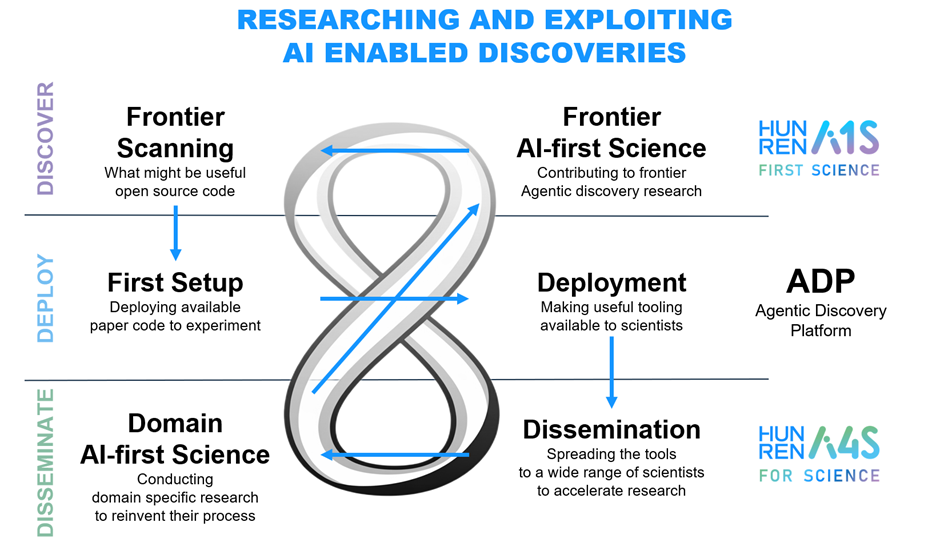
We follow, test and interpret new AI methods that could transform scientific work more deeply: hypothesis generation, autonomous research processes, data analysis, simulation design and the scientific evaluation of AI Scientist systems.
Many promising AI for Science methods still exist only in research papers, code repositories or prototypes that are hard to use. We turn the most promising ones into tools that can be tested, adapted and built into real research workflows.
AI can only have a system-wide impact on science if researchers use it widely. The AI ambassador network, training, expert support and the Agentic Discovery Platform are there so that researchers can try out the latest AI capabilities in their own fields.
In the AI1Science research strand, we study how AI can become a reliable, verifiable contributor to scientific work. Proven results become research tools and ADP features.
Parameter priors for Bayesian model calibration, drawn from the literature and traceable to their sources.
Symbolic regression with literature context, coherence checks and scientific explanation.
Breaking large process models down into modules and simplifying them, while keeping them interpretable.
More accurate database queries with locally run language models, by optimising the database schema.
Detecting and reliably assessing scientific texts generated entirely by AI.
Agent-based preliminary review of scientific manuscripts, with human expert oversight retained.
Estimating the expected scientific impact of publications from their abstracts.
Automated research integrity checks for published and forthcoming scientific papers.
Hollós et al. · Geoscientific Model Development 19(10), 2026
Preprint: arXiv:2608.11210, 2026
ICLR 2027 (submitted manuscript)
For us, AI-first Science does not mean science without people. Human expertise, domain knowledge, critical evaluation and responsible decision-making remain central. The aim is for AI to strengthen scientific integrity, not weaken it.
Our work is in line with European AI regulation. AI use is logged, auditable and transparent.
With locally run models, data stays within HUN-REN infrastructure. A tool's security category shows whether it sends data to an external provider. Protecting research data, intellectual property and personal data is a priority for every tool.
AI does not replace researchers; it complements them. Final decisions, validation and responsibility always remain with people.
We provide a common framework, tools and training. At the same time, each institute decides on its own AI strategy.
We support institutes with research support, training, tools and community building. Institutional AI ambassadors are the link between us and each institute.