
AI-supported mathematical problem-solving at the Rényi Institute
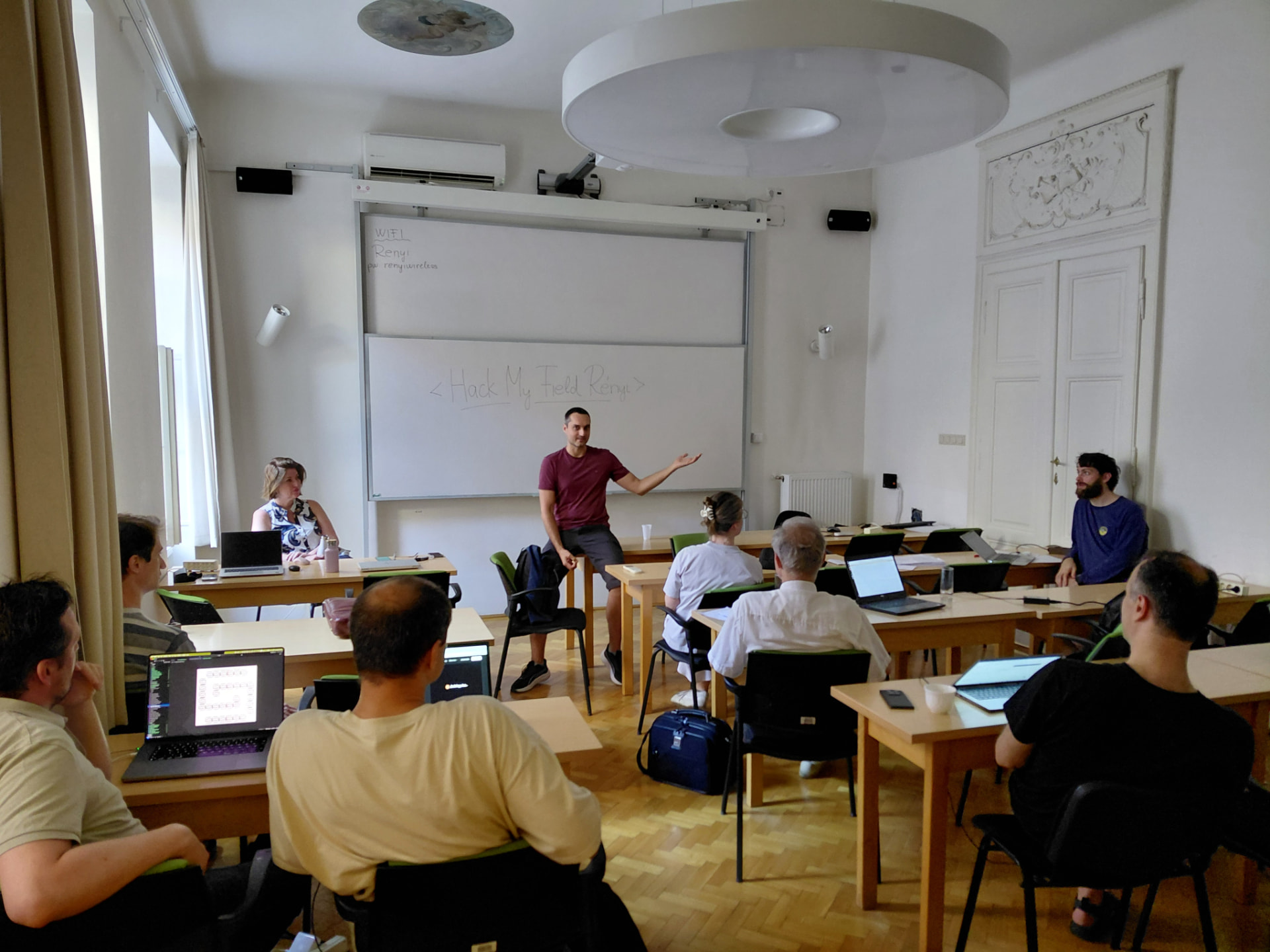
At the second Hack My Field event, researchers from the HUN-REN Alfréd Rényi Institute of Mathematics and experts from the AI Service Centre worked together on real mathematical research problems. During the one-day sprint, AI delivered tangible results in checking manuscripts, searching for algorithms, examining geometric conjectures and numerical optimisation.
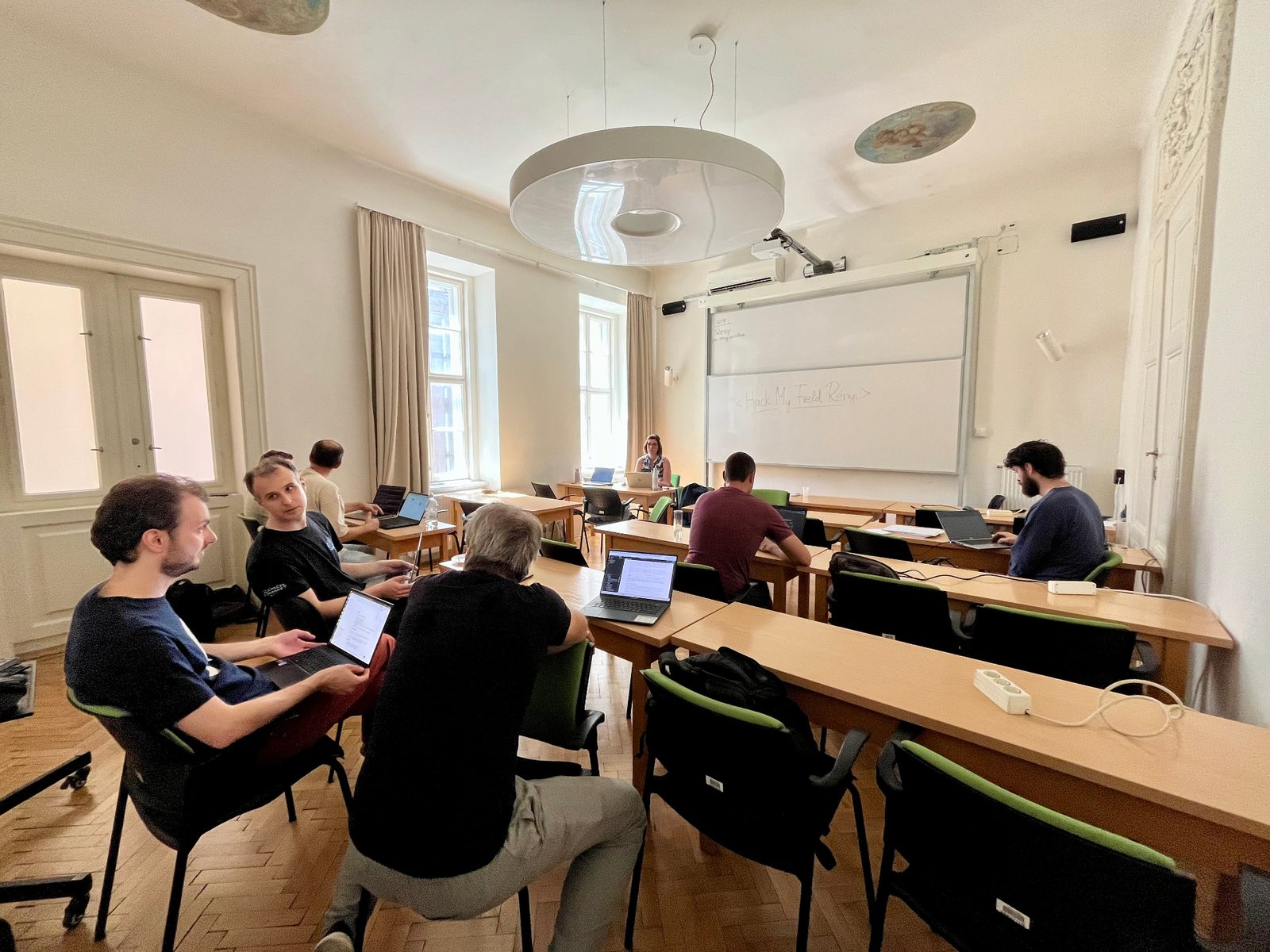
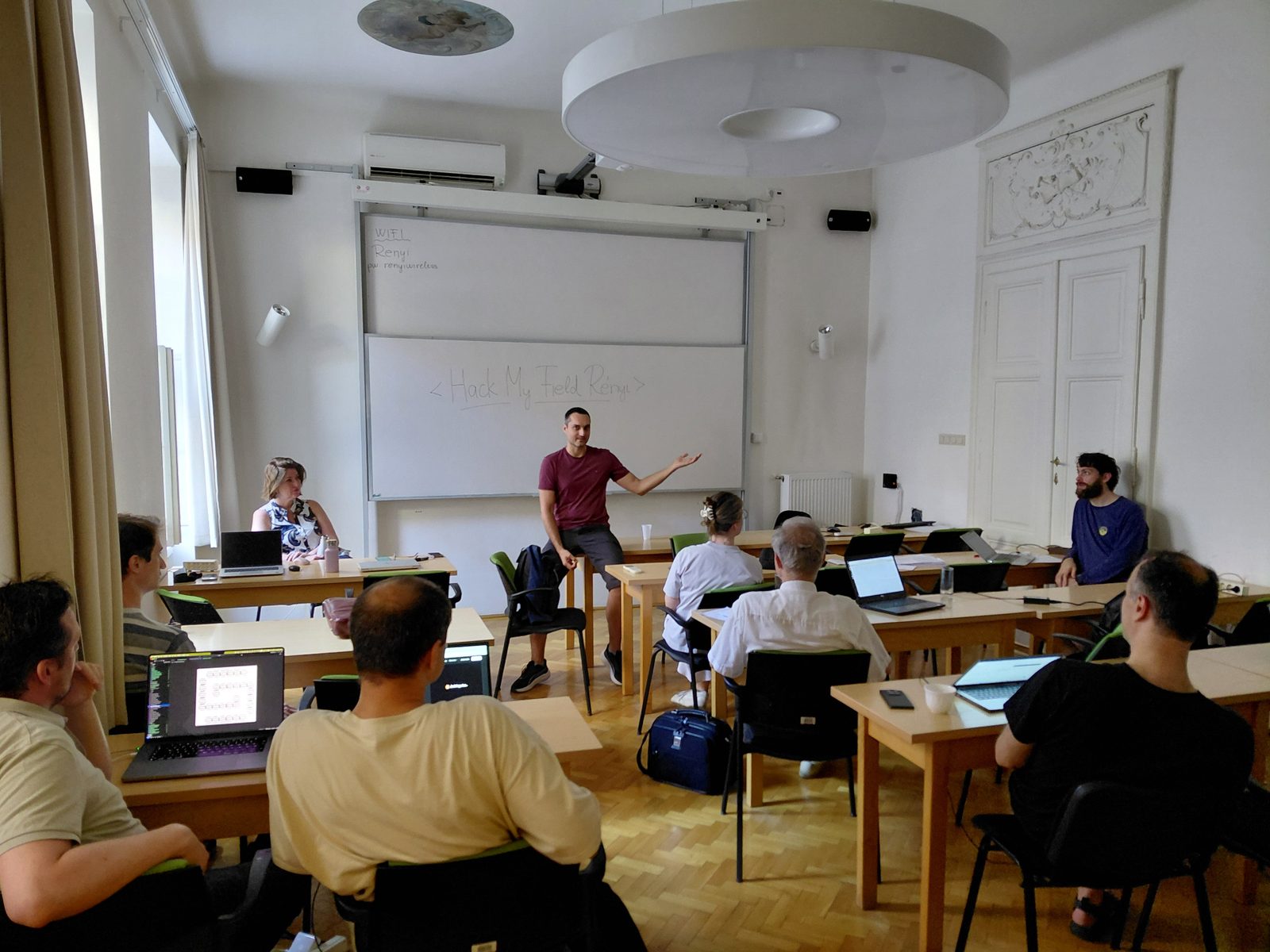
The second Hack My Field event organised by the AI Service Centre took place on 26 June 2026 at the HUN-REN Alfréd Rényi Institute of Mathematics, focusing on how artificial intelligence can be applied to real, research-level mathematical questions.
The idea behind Hack My Field is that researchers bring questions from their own current work, and experts from the AI Service Centre work intensively with them to find out where and how AI tools can genuinely help.
At the Rényi Institute, AI-based support came in at several very different points of the research work: checking manuscripts, searching for combinatorial constructions, proving inequalities, examining geometric conjectures and numerical optimisation.
Checking manuscripts and critical expert reading
One task concerned an old mathematical manuscript by Miklós István that had been left unfinished for some time, and on which Csóka Győző and Csóka Endre (Rényi) worked. The question was how well a state-of-the-art language model could understand the structure of the text, identify smaller errors in the proof, and make useful suggestions for missing or uncertain parts.
The experience was positive, but with important limits. The model pointed out several small but professionally relevant problems that were not directly part of the original question. One statement needed refining, and one case distinction turned out not to cover all the necessary cases.
At first glance these might look like minor wording or typing errors, but they can be essential when finalising a proof. The model also suggested solutions for two longer missing parts; these are still being checked by experts.
One of the most important lessons was that AI can be a useful critical reader, but only if the researcher keeps checking that it is really answering the right question and validates every statement professionally.
Searching for algorithms for lattice points
Another problem, brought by Szabó Dávid and worked on by Szabó Gergő (AISC), asked how many points can be chosen from an n x n grid so that *every* line contains at most two chosen points and *every* circle at most three. The research goal was to find a construction or algorithmic strategy that could beat the best currently known solutions, even if only for specific values of n at first.
Here, the AI-based approach did not start as a classic question-and-answer exchange but as an algorithm search. As the task had a well-measurable objective function, the team tried an evolutionary, language-model-assisted algorithm search (AlphaEvolve). Based on mathematical theorems and lemmas, the system looked for ideas on how to generate new constructions.
The results of the first round were both encouraging and sobering. The system was able to regenerate the researcher's already published algorithm, but did not find a better version. This is not a failure in itself, as it gave an important methodological lesson: if the search starts from an already very strong algorithm, the evolutionary approach may not be creative enough to find a genuinely new direction.
One possible way forward is therefore for the system not to start from the existing solution, but to try to build new algorithms from scratch.
Proving an inequality with computational support
The task brought by Pintz János, on which Szabó Gergő (AISC) also helped, narrowed down to proving a specific inequality as part of a larger mathematical project. The approach here was more computational: parameter ranges were explored with a grid search, and derivatives and integrals were then checked with symbolic computation tools.
One important result was that the model identified an error in the formula it had been given right at the start. This was most likely a simple typo.
Further investigation also showed that one of the expected positivity conditions is not automatically met everywhere, so completing the proof requires a more precise account of how the Taylor series can be used.
According to the researcher's feedback, this work was particularly useful and promising. It did not solve the whole problem in one day, but it moved an important part of the proof forward and produced a documented starting point for further work.
Fractal-like obstacles and testing geometric intuitions
The question brought by Székely Gergely, on which Kiss Konrád (AISC) worked, related to a geometric conjecture. Put simply, the question was how much a locally non-separating closed set can act as an obstacle. In other words, how much can it lengthen the path between two points if the set has to be avoided, with distance measured in the usual Euclidean metric?
The initial intuition was that such a set might not be able to form a serious obstacle. During the joint work, however, it was precisely the opposite direction that became exciting: it emerged that sufficiently complex fractal-labyrinth constructions might, after all, make the detour arbitrarily long.
Here, AI mainly helped with generating and visualising constructions. Once the technical environment had been chosen, the team began generating algorithms that can create increasingly complex shapes. Various MCP-based connections and tool integrations also played a role, allowing the generated constructions to be passed quickly to other systems for further analysis and visualisation. Integrating OpenEvolve for a similar purpose was also considered.
By the end of the day, the team had created basic algorithms with which the constructions can be built into programs and studied further. Although the full mathematical picture still needs more work, the experiments already showed, through concrete examples, how the length of the detour can grow for different constructions. This case showed that AI can be useful not only for producing ready-made answers, but also for quickly turning researchers' intuitions into objects that can be tested and visualised.
Numerical optimisation and confirming existing constructions
The numerical optimisation task brought by Ráth Balázs, on which Kobza Attila (AISC) worked, related to a paper in preparation. The question was whether, in an optimisation problem that can be traced back to the eigenvalues of sparse matrices, there is a better construction than the one the authors present in the paper. The problem originally came from probability theory, but it could also be treated as a numerical optimisation task that is easy to visualise.
The joint work started an iterative search process. Several agents ran in parallel, also checking each other's results, while the researcher and the AI expert continuously refined the approach. The system pitted different constructions and vortex-like solutions against each other, then visualised the results.
In the end, the process could not beat the construction in the paper. In this case, that was a particularly good result. The aim was not necessarily to find a better solution, but to see how strong the existing construction appears in the light of a computational search.
According to the researcher, this was a reassuring result. It does not, of course, replace a theoretical proof, but it gave more confidence for finalising the paper.
What did the day show?
One of the most important lessons of the Hack My Field day at the Rényi Institute was that AI-supported research is not a single type of work. In some cases AI acted as a critical reader; in others it searched for algorithms, checked formulas, generated shapes or explored numerical optimisation spaces.
It also became clear that in mathematical research, AI only makes sense under strict human control. A convincing-looking answer is not in itself a result. A result begins when the step suggested by the model can be checked, documented and re-run, and can be built into further work based on the researcher's professional judgement.
By the end of the day, there was tangible progress on several problems. Errors came to light, new approaches emerged, algorithms and visualisations were produced, and for one paper in preparation, confidence in the existing construction grew. Just as importantly, in several cases the result was not only a partial result but a workflow that can be continued.
This is the real value of the Hack My Field format. AI does not appear as a general promise, but as a tool that has been tried, checked and can be developed further in concrete research situations – one that can genuinely support the next steps of scientific work.